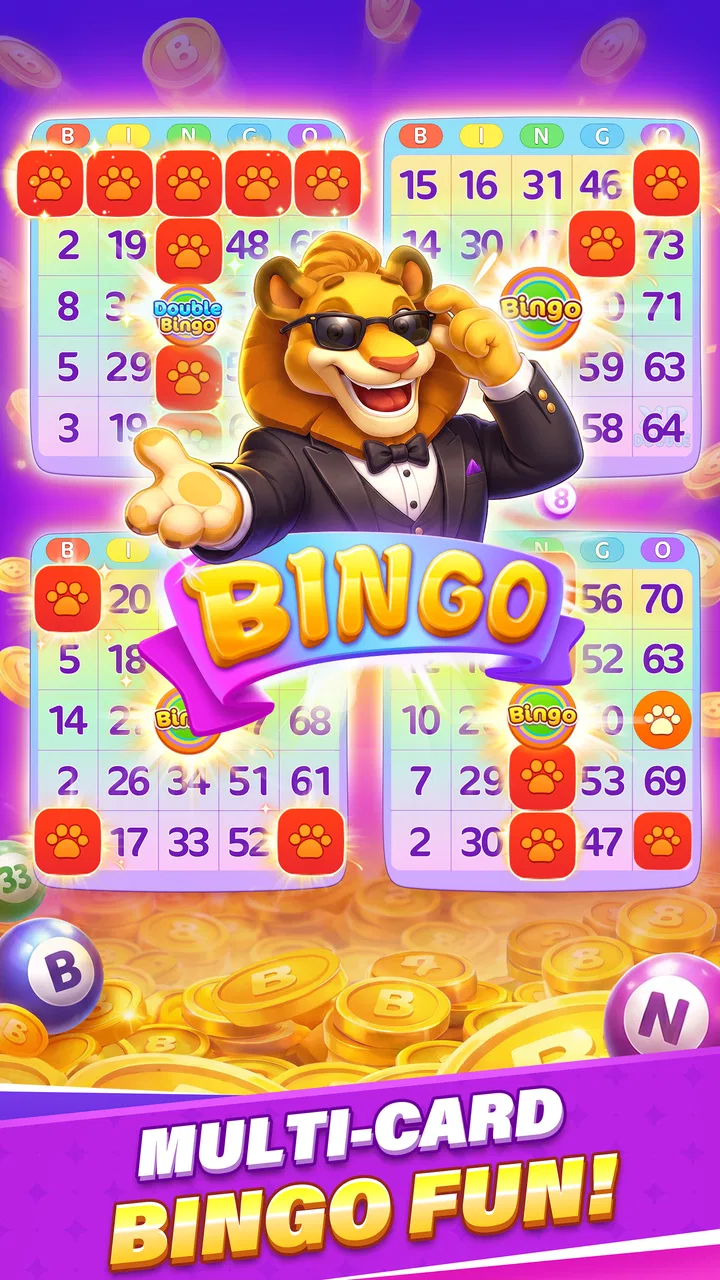
Bingo Wild-Classic Bingo Games
- 4.7
- Rating
- 1.00M
- Installs
- Free
- Price

 Analysis by App-foxy
I came to Bingo Wild-Classic Bingo Games expecting a familiar number-marking game, but its appeal became clearer after a few rounds: the pleasure is in the quick cycle of choosing a card, watching numbers appear, marking useful matches, and deciding whether the next draw might complete a line. It is a free board game from VividJoanGames, rated for Everyone, and it works on devices running Android 6.0 or later. That makes it easy to approach, although its optional purchases range from $0.99 to $159.99 per item, so I would still check spending controls before handing the phone to a child.
The game has built a sizeable audience, with over 1 million installs, an average rating of 4.7 from around 95 thousand ratings, and roughly 7 thousand reviews. Those figures suggest that the basic idea is landing well with many players, but they do not remove the need to decide whether this particular style of bingo fits you. In my experience, it is best understood as a short-session casual game rather than a deep strategy title. The fun comes from tension, timing, and the small satisfaction of a card coming together—not from building a complicated long-term plan.
How the bingo loop feels from the first tap to the next round
I find the appeal of a bingo round is how quickly a small decision becomes a reason to keep watching: I scan the card, note a promising pattern, and then see whether the next call changes my plan. That section looks at why this simple loop can feel absorbing without requiring much setup. From there, I turn to the practical checks that help a short session start smoothly.
You May Also Like

 Blood Strike: 2.5 Anniversary
Blood Strike’s Loadouts Turn Every Drop Into a Tactical Gamble
A close look at Blood Strike’s custom loadouts: how fast access to signature weapons reshapes its battle royale rhythm, rewards preparation, and narrows the gap between fights.

 Pandora - Music & Podcasts
Pandora’s Music Is Easy to Start, but Harder to Recover
Pandora’s strength is its low-effort path from a seed to a station. Its weak spot is how much confidence it asks you to place in connection, setup, and quiet recovery.

 8 Ball Pool
 Is Built on Rivalries, Rematches, and Routine
A close look at the rivalries, rematches, shared routines, and unanswered safety questions that turn a quick pool match into a persistent mobile community.

 Samsung Music
’s Quiet Strength Is Playing What You Already Own
Its reach comes less from spectacle than from dependable access to a personal library. That simplicity is both the app’s strongest retention engine and its ceiling.

 AccuWeather: Weather Radar
AccuWeather Review: A Quick, Clear Forecast for Everyday Decisions
For everyday plans, the best forecast is the one you can understand quickly. AccuWeather makes rain timing, radar, and local conditions easy to act on, with a few trade-offs.

 Hill Climb Racing
Why Hill Climb Racing Still Turns Crashes Into One More Run
A tiny car, a bumpy hill and one more upgrade: Hill Climb Racing keeps resurfacing because its simple chaos makes every near-miss feel personal.
More From Our News Desk



The first action is simple, and that is part of the appeal
The strongest quality of this game is that it gets to the recognizable action quickly. Bingo does not require a long tutorial to explain its central idea: numbers are called, matching spaces matter, and a completed pattern is the goal. That quick entry is useful when I want something I can play without preparing for a large commitment or learning a new control scheme.
When I start a round, my attention immediately moves between the called number and the card in front of me. That sounds basic, but it creates a surprisingly effective first step. I am not exploring a map, arranging a deck, or waiting for a complex turn structure. I am scanning, checking, and making a small decision about where the current number matters. The interaction suits a phone because each action is easy to understand even when I am playing with one hand.
That accessibility also explains why the Everyone age rating feels appropriate. A child can understand the visible goal, while an adult can enjoy the familiar rhythm without needing a lengthy explanation. I would still supervise purchases, because the game is free to download but includes paid items. The core attraction is approachable; the spending side deserves the same practical attention as any other free-to-play game.
One useful way to play is to treat the opening calls as information rather than immediate pressure. I look for which parts of my card are beginning to develop a pattern, then keep checking those areas as new numbers arrive. It is tempting to stare only at the almost-complete line, but doing that can make me miss a more promising combination elsewhere. This is a small habit, yet it makes the round feel more active than simply waiting for luck.
The feedback rhythm keeps ordinary calls interesting
The middle of a round is where the game earns its place as a casual time-filler. Each call produces a tiny piece of feedback: a number may matter, may be irrelevant, or may bring a visible pattern closer to completion. The individual moments are small, but they stack into a steady rhythm. I mark a match, scan again, and wait for the next opportunity.
That rhythm is more important than any single call. A missed number does not end the experience; it simply resets my attention toward the next one. A useful match, on the other hand, gives an immediate lift because I can see the card becoming more complete. This balance prevents every draw from feeling equally flat. Some calls are quiet, while others suddenly make the finish feel possible.
I also like that bingo naturally creates a tension between patience and optimism. If a line is close, I start imagining the number that would finish it, but I cannot force that number to appear. The game therefore gives me a reason to stay engaged without pretending that every decision can control the result. For players who enjoy light chance-based play, that uncertainty is the point. For players looking for a skill-heavy board game, it may feel too dependent on luck.
A practical tip is to avoid treating an almost-complete line as a guarantee. I have found the experience more enjoyable when I watch the entire card and accept that the promising route may not be the winning one. This reduces frustration and helps each round feel like a fresh puzzle of possibilities instead of a test I was supposed to solve perfectly.
The compact feedback loop also makes the game suitable for interruptions. I can play during a short break, put the phone down, and return when I have time for another round. It does not demand the same uninterrupted concentration as a long board-game session. That convenience is one of its clearest strengths, especially for people who want a quick diversion rather than a hobby that occupies an entire evening.
Winning supplies the reward, but the anticipation does most of the work
The reward in a bingo game is not only the final win. The card gradually filling in provides a sequence of small confirmations, while the possibility of completing a pattern gives the round its emotional pull. When a call finally connects the pieces I have been watching, the result feels satisfying because I have followed that card from uncertainty to completion.
What I appreciate is the way the reward arrives in layers. First there is recognition: a called number belongs on the card. Then there is progress: the marked spaces begin to form something meaningful. Finally there is the result of the round. That structure is why a simple game can encourage another attempt even when the previous one was not successful. The next card offers a new arrangement and a new chance for the same sequence of anticipation and payoff.
Still, the reward is best for people who enjoy modest victories. This is not the kind of board game where I am developing a sophisticated strategy over many turns or mastering a large set of mechanics. Its satisfaction is immediate and repetitive by design. If I want deep planning, player negotiation, or a campaign with substantial progression, I would choose a different category of game.
The free entry point helps curious players test that loop without paying at the start. However, the presence of in-app purchases means I would not describe the experience as entirely free of commercial pressure. I pay attention to whether I am enjoying the actual bingo decisions or merely chasing the next reward. Setting a personal limit before playing is sensible, particularly for anyone who is easily drawn into repeated attempts.
Another useful approach is to decide what a successful session means before beginning. Sometimes I play for one completed round, sometimes I stop after a win, and sometimes I stop after a reasonable amount of time. That simple boundary keeps the reward in perspective. It also prevents the familiar temptation to continue only because the next round might finally deliver the result I wanted.
The reset is what makes another session feel inviting
After a round ends, the game’s biggest advantage is the clean reset. The previous card no longer controls my attention, and I can approach the next one without carrying a complicated set of consequences. That makes the game welcoming for casual players who do not want to remember a storyline, maintain a collection, or recover from a difficult failure.
The reset also explains why the title works well in everyday situations. Imagine waiting for an appointment with a few quiet minutes available. I can begin a round, follow the calls, and decide whether to continue when it ends. On a commute, the short-cycle structure gives me something to do without requiring the sustained commitment of a strategy match. At home, it can work as a relaxed activity between chores or while taking a break from a more demanding game.
There is a trade-off here. A clean reset is friendly, but it can also make the experience feel repetitive over time. The central action remains familiar: observe the call, mark the matching space, watch the pattern, and repeat. Players who need constant novelty may lose interest sooner than players who enjoy a dependable routine. I would consider this a comfort-game quality rather than a flaw, but it is important to know what kind of replay value you are getting.
The reset is also why I would recommend it more readily to casual bingo fans than to people searching for a traditional tabletop replacement with a social atmosphere. Playing on a phone offers convenience and immediate access, but it cannot fully reproduce the conversation, shared suspense, or physical presence of sitting around a table with other people. If the social ritual is the main reason you enjoy bingo, a real-world game or a more explicitly multiplayer-focused alternative may suit you better.
Where it stands beside other board-game alternatives
Compared with classic physical bingo, this version is more convenient and less dependent on preparation. I do not need cards, markers, a caller, or a group ready at the same time. That makes it a practical solo option when I want the recognizable pattern-completion experience immediately. The compromise is that the phone handles the atmosphere and pacing, so the experience can feel more contained and less communal.
Compared with digital card games, it asks for less long-term planning. A card battler may reward deck construction, resource management, and careful sequencing across many matches. Here, the attention is narrower and more immediate. I am responding to the current card and the current call, not managing a larger strategy system. That simplicity is excellent when I want low mental overhead, but it will not satisfy someone who enjoys building an elaborate advantage.
Compared with puzzle board games, the balance also leans toward chance. A logic puzzle usually gives me enough information to reason toward a solution, whereas bingo asks me to respond well to numbers that arrive outside my control. I can scan intelligently and avoid tunnel vision, but I cannot manufacture the call I need. That makes the game relaxing for some players and unsatisfying for others.
For families, the Everyone rating and clear visual objective make it approachable, but I would explain the purchase system before letting younger players use it independently. For older players, the appeal is likely to be the familiar format and quick pacing rather than challenge. For someone who wants a calm, low-commitment board game on a compatible device, it is an easier recommendation than for someone who wants competitive depth or a strongly social experience.
Small habits that improve the experience
I get more from each round when I keep my scanning routine consistent. I check the newly called number, review the card as a whole, and only then focus on the strongest developing pattern. This prevents me from overlooking useful matches simply because one line looks exciting. It also gives the round a deliberate feel without turning a casual game into hard work.
I also recommend playing with a clear stopping point. The reset is designed to make another round feel effortless, which is convenient but can blur the boundary between a short break and a much longer session. Stopping after a chosen number of rounds, after a win, or when attention starts to fade helps preserve the game’s light character.
On a shared device, I would keep purchase controls protected and make sure the player understands that free installation does not mean every optional item is free. That is not a criticism of bingo itself; it is simply the most important practical consideration for a game aimed at a broad age range. The safest experience is one where the player can concentrate on the card rather than making accidental spending decisions.
Finally, I would not judge the game by a single unlucky round. Since chance is central to the format, one poor result says little about whether the loop suits you. I would play several short sessions and ask a more useful question: do I enjoy the repeated process of scanning, marking, waiting, and resetting? If yes, the simplicity becomes a strength. If no, additional rounds are unlikely to transform it into a deeper strategy game.
My verdict on the complete loop
From the first number call to the decision to begin again, the game succeeds because every stage is easy to understand. The action is immediate, the feedback arrives in small but regular steps, the reward comes from both progress and completion, and the reset removes friction before the next attempt. That is a well-shaped loop for short, casual play.
Its limitations are equally clear. Luck sits at the center, repeated rounds can become familiar, and the optional purchases mean I would play with sensible spending boundaries. It is not my pick when I want rich strategy, a strong social table, or a substantial progression system. In those situations, a deeper board game or a group-based bingo experience would be a better choice.
For the right player, though, the best reason to try it is the dependable few-minute cycle: open a card, watch the pattern develop, enjoy the suspense of the next call, and start fresh without a complicated reset process. The current version is 1.5.2, and the game remains free to start on supported Android devices. I would recommend it to anyone who likes familiar bingo, wants an uncomplicated board-game break, and understands that its charm comes from repetition rather than depth.
FAQs for Bingo Wild-Classic Bingo Games
01What is Bingo Wild-Classic Bingo Games, and how does it differ from other bingo apps?
Bingo Wild-Classic Bingo Games is an engaging and vibrant bingo app that offers a classic bingo experience with a modern twist. Unlike other bingo apps, it features a variety of themed rooms, power-ups, and special events that enhance gameplay. Additionally, the app includes social features that allow players to connect with friends or compete against other users worldwide.
02Is Bingo Wild-Classic Bingo Games free to play, or are there in-app purchases?
Bingo Wild-Classic Bingo Games is free to download and play, offering a wide range of features at no cost. However, it does include optional in-app purchases that can enhance the gaming experience. These purchases can include additional tickets, power-ups, and exclusive items that can help progress through the game more quickly or unlock special features.
03Does Bingo Wild-Classic Bingo Games require an internet connection to play?
Yes, Bingo Wild-Classic Bingo Games requires an active internet connection to access its features and play with others online. The internet connection ensures that players can participate in live events, access leaderboards, and utilize social interaction features, such as chatting with friends or joining multiplayer games.
04What devices are compatible with Bingo Wild-Classic Bingo Games?
Bingo Wild-Classic Bingo Games is available for both Android and iOS devices. To ensure optimal performance, it is recommended to use a device running at least Android 5.0 or iOS 10.0. The app is optimized for a variety of screen sizes, making it suitable for both smartphones and tablets.
05Are there any age restrictions for playing Bingo Wild-Classic Bingo Games?
Bingo Wild-Classic Bingo Games is designed for players of all ages, but it is recommended for ages 12 and up due to its in-app purchase options and online interactions. Parents should monitor younger players to ensure a safe and enjoyable gaming experience, particularly concerning online interactions and spending.
Pros
- Engaging daily challenges keep players returning.
- Variety of themes adds visual appeal.
- Smooth and intuitive user interface.
- Regular updates with new features.
- No mandatory ads disrupt gameplay.
Cons
- In-app purchases can get pricey.
- Limited offline play options.
- Occasional connectivity issues.
- Some features require long playtime to unlock.
- Lacks advanced strategy elements.

Bingo Wild-Classic Bingo Games
Gallery